A new model is out, and you're seeing a table where they're showing that "Our model got a bigger number than competitors on this acronym!". Besides the obvious big number = good thing, and small number = bad thing, what do these numbers actually mean?
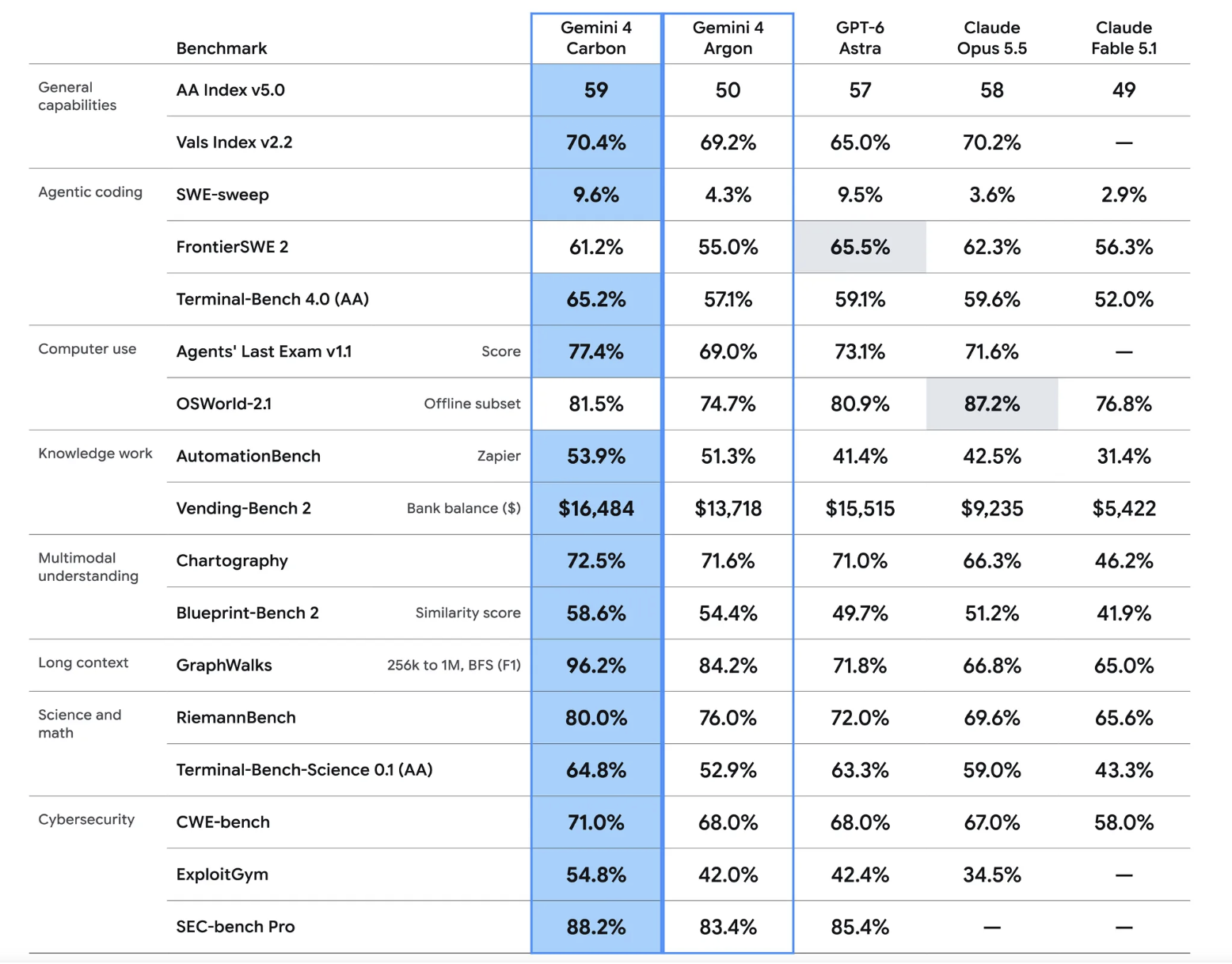
There are a lot of benchmarks here. Even more so, some of them are indexes which themselves contain a lot of benchmarks. Going to each and every one of them would make for a bad article, so I'll just be covering the Artificial Analysis Intelligence Index (AA Index) for now. If you'd like to see a breakdown of the others, let me know in the LinkedIn comments.
Artificial Analysis (AA) is an independent company that benchmarks AI models and API providers. Today, I'm going to break down this index and the benchmarks it comprises to hopefully give you an idea about what these benchmarks actually test.
The Number At The Top: AA Index v5.0
You may have noticed that this is at the very top of the table and it falls under "General capabilities". There is a good reason for that: this is an aggregate score on several benchmarks, testing the following capabilities:
- Knowledge Work: AA-Briefcase v1.1, AutomationBench-AA, GDP.pdf
- Coding: FrontierCode 2.0, Terminal-Bench 4.0
- Science: Terminal-Bench-Science 0.1, CritPt v2 (Hard Subset)
- General: AA-Omniscience v1.1, HLE-Diamond
The final score is the average of the score for each category, with equal weighting.
AA run the evaluations themselves, with the methodology being provided here.
The Benchmarks
Let's go through each of these nine benchmarks, grouped by the same four categories AA uses.
Knowledge Work
First, the benchmarks that try to measure office work.
AA-Briefcase v1.1 (15% weighting)
- Grading: Non-deterministic (panel of LLM judges from different model families)
- Publicly available: No, only a single example task is published
- Dataset: AA-Briefcase-Lite (example)
- Details: AA-Briefcase evaluation page
This benchmark contains long-horizon, multi-week projects designed by industry experts. The benchmark itself is private, but I think we can get a reasonable understanding of the type of task from their singular published example. "A week" of tasks demands creating documents, presentations and videos about market research, forecasts, opportunities, risks, preliminary findings, etc.
The model is not given access to the internet, but it is given access to hundreds of files of data on which to base its work (PDFs, Slack exports, app-store pages and a lot of other formats). The models are tested in Stirrup, AA's open-source agent harness.
Grading is done by a panel of LLMs from different model families in order to alleviate in-family biases (LLM judges have been shown to recognize and favor their own outputs, so a single judge can tilt the scale towards its own family).
AutomationBench-AA (5% weighting)
- Grading: Deterministic (checks the right data ended up in the right apps, plus negative assertions)
- Publicly available: Partially. 600 public tasks; the AA Index uses a held-out private set of 657 tasks
- Dataset: zapier/AutomationBench on GitHub
- Details: AutomationBench paper
This is AA's run of Zapier's AutomationBench.
This tests a model's ability to run actual business workflows in the actual applications that a business may use. So for example email applications, CRM applications, spreadsheets, marketing tools, etc. What is actually being tested is whether the model can chain multiple software products together to arrive at a desired result.
The tasks span the Sales, Marketing, Operations, Support, Finance, and HR departments of a company. An example of a finance task would be processing a vendor payment.
Some of the tasks are public, but the ones AA scores models on come from a held-out private split of 657 tasks (a bit more than the 600 public ones).
Grading is deterministic for this benchmark. All that is checked is that the right data is present in the right applications. Of course, there are some negative assertions as well for "bad" actions.
GDP.pdf (5% weighting)
- Grading: Non-deterministic (GPT-5.6 Luna (medium) as judge, per criterion)
- Publicly available: Yes (gated, requires a Hugging Face account)
- Dataset: surgeai/GDP.pdf on Hugging Face
- Details: GDP.pdf paper
This is AA's run of Surge AI GDP.pdf.
What is tested here is multimodal reasoning over a PDF document: You give a model a PDF containing text, images, charts and so on and you ask it questions about said PDF. The fields covered by this are Finance, Healthcare, Legal, STEM/Research, Engineering, Construction, Manufacturing/Supply Chain, Insurance, Real Estate, and Human Resources. The dataset comprises 100 tasks, graded against 1,275 criteria.
Compared to the previous datasets, this one is public on Hugging Face, so you can take a look for yourself (it's gated, so you will get a 404 unless you are logged in). Little side note here: these captchas are getting out of control. Hugging Face asked me to perform a captcha and it was actually difficult.
The fact that the dataset is public is a drawback here for me. Sure, you can try it yourself if you are developing or finetuning models (which is a plus), but it is extremely likely to seep into the training data for the next generations of models. We'll see how it goes, but this was a pretty big problem for math datasets, addressed with techniques like only using recent math contests (MathArena).
AA takes a different approach for evaluation than the original authors: Surge AI gives the model the raw PDF, while AA separates the text and the images. Grading by AA is done using GPT-5.6 Luna (medium) as a judge and each criterion is judged independently. What's interesting to me is that there is no variety in model family used as a judge here.
Coding
From the office to the codebase.
FrontierCode 2.0 (15% weighting)
- Grading: Mixed. Tests, linter and build checks are deterministic; test adaptation and code-quality review are done by an AI agent
- Publicly available: No, the 132 tasks are private to avoid contamination
- Dataset: Example tasks on AA
- Details: FrontierCode 2.0 announcement
This is a benchmark built by Cognition. What they did was to put together 20+ open-source project maintainers and ask them to craft a set of coding tasks for their respective codebases.
The total number of repositories is... well... not very clear to me. For FrontierCode 1.0, Cognition states that they have "collaborated directly with the maintainers of 36 flagship open-source repositories". For FrontierCode 2.0, they say that "our tasks are drawn from 55% more repositories". So doing the math, we arrive at 36 * 1.55 = 55.8 repositories. I'm getting flashbacks from physics class, where I once calculated that an object would need a mass of roughly -3 kg to move that quickly.
Putting that aside, what FrontierCode measures is how well a model can implement a task described informally (so not a great amount of details) fully autonomously. They verify the following points:
- the code behaves as it should, verified by injecting predetermined tests into the repo after the task is completed. Given that problems can have multiple solutions, a custom AI agent is asked to adapt the tests to the solution if needed.
- the previous tests pass, so no regressions
- the code compiles and passes the repository's linter
- the modifications were limited in scope to only what was asked
- code quality is checked by an AI agent (GPT-6 Luna (medium) in the case of AA)
Terminal-Bench 4.0 (10% weighting)
- Grading: Deterministic (scripted checks)
- Publicly available: Yes
- Dataset: Tasks on GitHub (v4.0.0)
- Details: Terminal-Bench 4.0 announcement
This is a coding benchmark with a pretty big variety of domains and task types. The agent is given a sandbox with some files and has to accomplish a certain task. The tasks span from "create a script that removes JavaScript from HTML" to "go find out something about these amino acid structures".
The tasks are closed-ended and the instructions clear, so evaluating the results is fairly simple. You can do so deterministically with a script.
Science
Terminal-Bench has a sibling for science, and physics gets a benchmark of its own.
Terminal-Bench-Science 0.1 (15% weighting)
- Grading: Deterministic (scripted checks, as far as I can tell)
- Publicly available: Yes
- Dataset: GitHub
- Details: Task list on Harbor
This is just like the Terminal-Bench from earlier, but with science workflows instead of coding workflows.
The tasks are, yet again, public. They span biology, medicine, ecology, astronomy, physics, chemistry, math, engineering and so on. If that helps you in any way, some example tasks are "you have these lakes, go classify them", or "Reconstruct, from the bundled satellite imagery alone, the freeze-up date and the ice-off date of the lake described below". (these are some of the ones I could at least understand)
The tasks are again graded deterministically (as far as I can tell from looking at the code for a few of them).
CritPt v2 (Hard Subset) (10% weighting)
- Grading: Deterministic (machine-verifiable, guess-resistant answers)
- Publicly available: No, the problems are unpublished
- Dataset: Example task
- Details: CritPt paper
There's no other way to begin this subsection other than telling you that I've just found out this is supposed to be pronounced "critical point".
This benchmark is based on an unpublished list of research-level physics problems. The full list has 70 problems. When CritPt v2 launched, 30 of them were solved by seven frontier models in all five attempts, so the "hard subset" is just the remaining 40 problems.
This benchmark is designed to have machine-verifiable answers that are guess-resistant. If you're wondering what "guess-resistant" means, it just means that the answers are things like numerical values, symbolic expressions or Python functions, not a simple "true" or "false". (apparently, there are a few yes or no answers, but they mitigate this problem by also asking some related questions). The benchmark also has some intermediate checkpoints to evaluate model progress, just like exam questions where the tasks are related, but they get more difficult.
If you are curious about what such a task may look like, check out the example linked above. Unfortunately, it seems like my quantum physics knowledge faded from the days where I used to do research in the field (more precisely: never).
General
Finally, raw knowledge and reasoning.
AA-Omniscience v1.1 (15% weighting)
- Grading: Non-deterministic (GPT-5.6 Luna (medium) as judge)
- Publicly available: Partially. 600 questions (a 10% subset of the original 6,000) are public
- Dataset: AA-Omniscience-Public on Hugging Face
- Details: AA-Omniscience paper
This benchmark verifies exactly what its grandiose name suggests: how much stuff the model knows. The dataset has 3000 questions (the original AA-Omniscience had 6000, but 3000 of them were removed because they were saturated) spanning Business, Humanities and Social Sciences, Health, Law, Software Engineering, and Science, Engineering and Mathematics. The answers are graded by GPT-5.6 Luna (medium).
What's interesting is that models are penalized for hallucinating/guessing/answering incorrectly. The grades are correct, partially correct, incorrect and not attempted. The original Omniscience Index is computed as:
Omniscience Index = 100 × (correct − incorrect) ÷ (correct + partially correct + incorrect + not attempted)
So it ranges from −100 to 100, and a model that is wrong as often as it is right scores 0. Partial answers and abstentions don't add or subtract points, they only count towards the total.
In the AA Index, it is split into two components: accuracy (10%) and 1 − hallucination rate (5%), where:
Hallucination rate = incorrect ÷ (partially correct + incorrect + not attempted)
In other words: out of all the questions the model did not get fully right, how often did it confidently give a wrong answer instead of saying "I don't know"? What's even more interesting is that, when the original benchmark was launched, only 3 models got positive scores.
HLE-Diamond (10% weighting)
- Grading: Non-deterministic (GPT-5.6 Luna (medium) as a pass/fail judge, on closed-ended answers)
- Publicly available: Yes
- Dataset: cais/hle-diamond on Hugging Face
- Details: Humanity's Last Exam paper
This is a refined version of the Humanity's Last Exam benchmark. There are 500 knowledge questions and 500 reasoning questions. The questions are at the frontier of human knowledge and do not have easily-searchable answers on the internet. The questions are multi-modal, with text and image references, covering science, humanities and everything you may already expect by now.
The tasks are graded using GPT-5.6 Luna (medium) with a pass/fail score. The questions are closed-ended, with a single definite answer, but the model writes it in free form. The LLM judge is needed because there are multiple ways of writing the same answer.
So, Should You Care About These Numbers?
Well, you should care about these numbers partly. Now that we've gone through what's inside the AA Index, here's what I'd look at before getting excited about a bold number.
First things first, look at benchmarks that match your use case. If you mostly use models for coding, a model topping AA-Omniscience tells you very little. The AA Index is an average of four very different categories, so a model can win the index while losing the one category you actually care about.
Second, check how the benchmark is graded. A deterministic check (tests pass, the right data ended up in the CRM) is a lot more trustworthy than an LLM judge. And when there is a judge, check who it is. Several of these benchmarks are graded by a single OpenAI model, while a GPT model sits right there in the comparison table. AA-Briefcase uses a panel of judges from different families for exactly this reason, and the other LLM-judged benchmarks don't.
Third, check whether the benchmark is public. Public datasets are great for reproducibility, but they are very likely to leak into the training data of future models. Private ones aren't bulletproof either: OpenAI funded FrontierMath and had access to much of its data, something that only became widely known after it posted record scores on it.
Fourth, check who ran it. The same benchmark can produce different numbers depending on the harness, the prompt and the settings. That's why the table above says "AutomationBench (Zapier)" next to "Terminal-Bench 4.0 (AA)". Numbers run by an independent party in the same harness are much easier to compare than numbers each lab reported for itself.
And finally, don't read too much into small gaps. Going back to the table at the top: 59, 58 and 57 on the AA Index is, for all practical purposes, a tie. If two models have similar scores, try out both of them. Maybe the output style of the theoretically lower-performing one matches your style more and it's more useful to you.